The Ethics of Efficiency: Why Faster Isn't Always Better
As AI makes everything faster, we must ask: Are we just doing the wrong things more quickly?

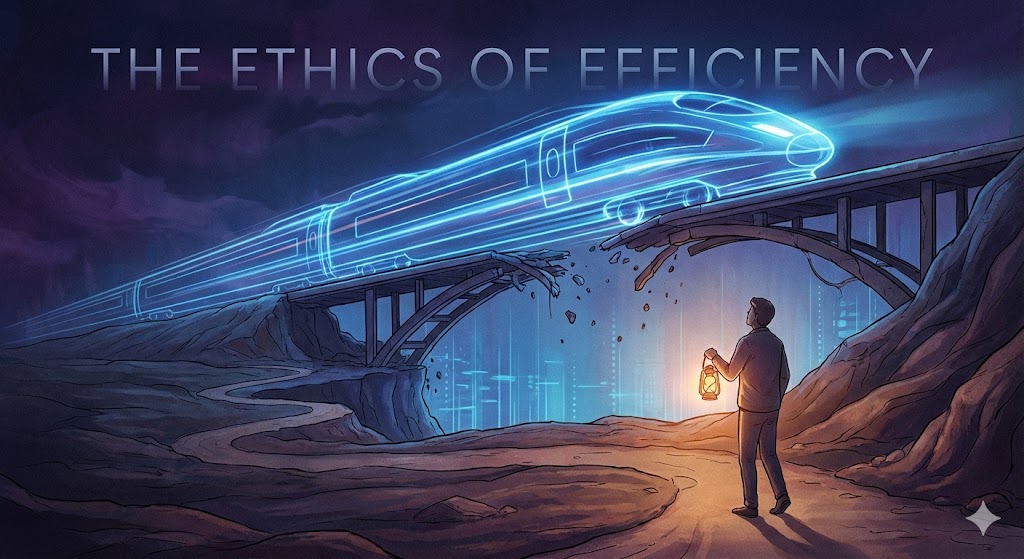
The Efficiency Trap
Efficiency is the favorite drug of the modern manager. If we can do it 20% faster, it’s a win. If we can reduce headcount, automate a workflow, or shave seconds off a transaction, we celebrate it as progress. Dashboards light up. Metrics improve. Quarterly reports look cleaner.
But efficiency is a multiplier, not an optimizer. It does not ask whether the thing being multiplied is wise, humane, or aligned. It simply accelerates whatever already exists. If you were doing something shortsighted and now you’re doing it 20% faster, you are just being efficiently shortsighted. In the AI era, this becomes even more dangerous. Because now it’s not 20% faster. It’s 200% faster. Sometimes 2,000%.
This is where the “Ethics of Efficiency” becomes critical. Before we deploy the tool, before we automate the workflow, before we celebrate the time saved, we have to pause and ask a more uncomfortable question: Is the speed serving the purpose? Or is the purpose being quietly reshaped to justify the speed?
I’ve seen organizations automate their customer service into a sterile wasteland of bots and scripts. Response times improved. Costs dropped. On paper, it looked brilliant. But something intangible eroded. Customers stopped feeling heard. Nuance disappeared. Trust thinned. They were more “efficient,” but they had undermined the very relationship that built their business in the first place.
Leadership is not the art of going faster. Leadership is the discipline of knowing when to slow down. It’s about choosing the long path when it’s the one that leads to depth, loyalty, and true quality. The temptation in the AI age is to believe that speed equals sophistication. It does not. Speed simply reveals what you value.
Stewardship vs. Speed
As leaders, we are not just managers of process. We are stewards of culture. We are stewards of trust. We are stewards of the brand’s soul. And souls are not optimized; they are cultivated.
If we sacrifice that soul at the altar of efficiency, we haven’t won. We have simply accelerated our own decline. The numbers may look good in the short term. The long-term cost is harder to see, but it is real. Employees disengage. Customers feel processed instead of served. Innovation becomes transactional rather than relational.
The “intent-inward” approach demands that we evaluate every automation through the lens of our core values. Not just “Can we automate this?” but “Should we?” Not just “How much time will this save?” but “What will this subtly teach our team about what matters?”
If the efficiency comes at the cost of empathy, it is too expensive. If it erodes accountability, it is too risky. If it distances us from the very people we claim to serve, it is a strategic failure disguised as progress.
This does not mean we should reject technology. It does not mean we should cling to manual systems out of nostalgia. It means we must be intentional architects. AI should remove drudgery, not responsibility. It should clear cognitive clutter so that humans can operate at a higher level. Efficiency should buy us time for quality, not replace it.
If automation gives your team two extra hours a week, what happens to those hours? Do they disappear into more output? Or are they reinvested into mentoring, deeper analysis, better conversations, and more thoughtful strategy? That choice reveals whether efficiency is serving stewardship or replacing it.
The Hidden Cost of Frictionless Systems
There is another subtle danger in the efficiency obsession: frictionless systems often remove the very pauses that produce wisdom. When every step is streamlined, every decision accelerated, and every interaction templated, we eliminate the micro-moments where reflection happens.
Friction is not always a flaw. Sometimes it is a safeguard. A second review. A human callback. A thoughtful delay before sending the automated response. These pauses can protect quality and integrity in ways that speed never will.
In high-stakes environments—healthcare, education, public safety—the stakes are even higher. Automating the wrong thing can scale bias. It can harden flawed assumptions into institutional practice. It can make errors more consistent and more difficult to detect. Efficiency without oversight is simply risk at scale.
The question is not whether we can build faster systems. We clearly can. The question is whether we are building wiser ones.
The Speed of Trust
Trust is a slow-growing asset. It cannot be automated. It cannot be bulk-generated. It is built through consistent, high-fidelity human contact. Through follow-through. Through nuance. Through care.
Paradoxically, trust is also the ultimate accelerator. Organizations with high trust move faster in the long run because they do not waste time repairing relational damage. They do not constantly renegotiate credibility. They operate from a foundation of confidence.
When we use efficiency to create more space for meaningful human interaction, we are leading with intent. When we use it to eliminate those interactions, we are simply being fast.
In the AI era, speed is easy. Wisdom is not. Automation is scalable. Character is not. The real leadership challenge is not mastering the tools. It is mastering ourselves—our impatience, our appetite for quick wins, our temptation to equate velocity with value.
Choose efficiency that amplifies your mission. Reject efficiency that corrodes it. Let technology handle the repetitive so that humans can handle the relational. If we get that balance right, speed becomes an ally. If we get it wrong, it becomes a liability disguised as innovation.
Choose wisely.
Written by Kyle P. Atkins, Ed.S., PMP, CVAHP, NRP, eFACHDM
Founder & Chief Architect of Veritas Technology Solutions , and author of The Healthcare Leader’s Guide to AI and SAFEHARBOR: A BLACKBOX Story .
More in Clinical AI & Governance
Leadership Dispatch
Occasional essays on healthcare AI governance, clinical education, and executive leadership. Sent directly when a new article or resource is published—no weekly filler.