Why I Wrote The Healthcare Leader's Guide to AI
AI is moving faster than most healthcare organizations can respond to. The Healthcare Leader’s Guide to AI grew from a simple question: how do we embrace what AI makes possible without losing the human judgment, accountability, and context healthcare depends on?

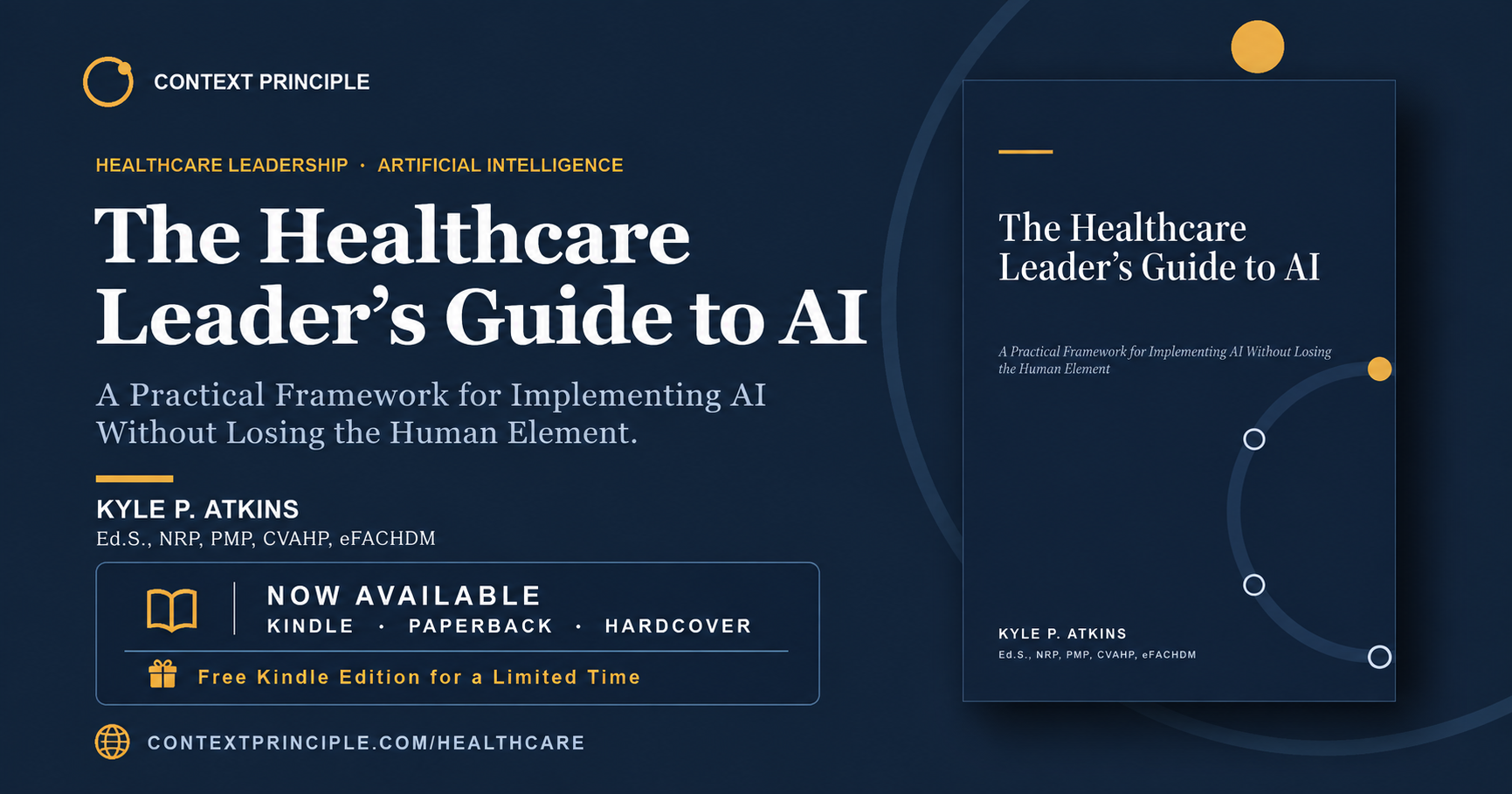
Why I Wrote The Healthcare Leader’s Guide to AI
Artificial intelligence is moving faster than most organizations know how to respond to it. That isn’t necessarily because healthcare leaders don’t understand that AI matters. In many cases, the opposite is true. Leaders are hearing about AI constantly. They are seeing new tools, new vendors, new capabilities, new promises, and new warnings almost every day.
The harder question is no longer whether AI will affect healthcare.
It is what we are supposed to do about it.
That question is what ultimately led me to write The Healthcare Leader’s Guide to AI: A Practical Framework for Implementing AI Without Losing the Human Element.
I Didn’t Want to Write Another Book About AI Tools
AI books have a particularly difficult problem: the technology can change faster than the book can be written.
The model that seems revolutionary today may be replaced tomorrow. Features change. Platforms disappear. Capabilities that once required specialized expertise become commonplace.
So I didn’t want to write a book built around a collection of tools or prompts that might be obsolete six months after publication.
I wanted to write about something more durable: How do we lead through this change?
Because regardless of which AI platform ultimately wins, healthcare organizations still have to answer some fundamental questions.
- What problem are we trying to solve?
- Why is AI the appropriate solution?
- What evidence supports its use?
- What risks does it introduce?
- Who is accountable for its decisions or recommendations?
- How will we measure whether it actually created value?
And perhaps most importantly: Where does the human remain in the process?
Those are not questions for an AI model to answer for us. They are leadership questions.
Start With the Problem, Not the Technology
One principle at the center of the book is simple: Start with the problem, not the technology.
That sounds obvious. In practice, it is surprisingly easy to reverse. A new AI platform appears. Someone sees an impressive demonstration. A vendor introduces an AI feature. Leadership begins asking where the organization can use it.
Suddenly, we have a solution searching for a problem.
I believe responsible AI implementation has to begin somewhere else.
- Start with the problem.
- Understand the workflow.
- Identify the people affected by it.
- Determine what outcome needs to improve.
- Understand the evidence.
Then ask whether AI is actually the appropriate intervention. Sometimes it will be. Sometimes a simpler technology will accomplish the same thing. Sometimes the existing process simply needs to be redesigned. And sometimes the right decision will be not to implement AI at all.
Being willing to reach any of those conclusions is part of responsible AI leadership.
Governance Has to Move as Quickly as Innovation
Healthcare organizations will have to confront another tension.
AI adoption can happen extraordinarily quickly.
Governance usually doesn’t.
An employee can create an account with a generative AI platform in minutes. A department can begin experimenting with an AI-enabled workflow before organizational leadership even knows it exists. Existing software vendors can introduce AI functionality into products already embedded throughout the organization.
That makes the traditional model of governing technology after implementation increasingly inadequate. Governance has to become part of implementation from the beginning.
And it cannot live exclusively inside IT.
AI touches clinical practice, operations, privacy, cybersecurity, compliance, education, finance, ethics, workforce development, patient experience, and organizational strategy. That means the people responsible for those areas need a seat at the table.
Responsible AI governance isn’t about slowing innovation down. It is about creating the conditions that allow organizations to innovate deliberately.
We Cannot Optimize the Human Out of Healthcare
The subtitle of the book was intentional: Implementing AI Without Losing the Human Element.
Healthcare is an unusual environment for technological transformation because efficiency is not the only outcome that matters. Trust matters. Judgment matters. Context matters. Communication matters. Accountability matters. And people matter.
An AI system may make a process faster without making it better. It may produce an accurate recommendation while introducing unacceptable risk somewhere else in the system. It may automate a task while unintentionally removing an interaction that was important to a patient, clinician, or employee. That doesn’t mean we should resist AI. Quite the opposite. I believe AI has enormous potential to augment human capability in healthcare. But augmentation and replacement are not the same thing.
The question shouldn’t simply be: What can AI do instead of us?
A much more useful question is: > What can AI enable us to do better?
AI Literacy Is Becoming a Leadership Competency
I also don’t believe every healthcare leader needs to become an AI engineer. They do, however, need enough AI literacy to participate meaningfully in the decisions their organizations are making. When someone walks into a leadership meeting and says, “We want to implement AI,” leaders need to know what questions come next.
- What problem?
- What evidence?
- What data?
- What risk?
- What governance?
- What human oversight?
- What implementation strategy?
- What measure of success?
- Who is accountable?
Those questions will remain important long after today’s AI models have been replaced. That’s why the book is ultimately less about mastering artificial intelligence and more about developing a framework for leading in an environment shaped by it.
The Book Was Never Meant to Stand Alone
I also wanted this to be more than something you read, put on a shelf, and occasionally reference. So I built a companion site around the book. At https://contextprinciple.com/healthcare, readers can explore the book, read a free sample chapter, and access six practical toolkits designed to help translate the concepts in the book into actual organizational work.
The goal is to bridge the gap between understanding the ideas and applying them. Because healthcare doesn’t need more AI theater. It needs leaders capable of evaluating this technology critically, implementing it responsibly, and knowing when not to use it.
That’s Why I Wrote This Book
I don’t expect anyone to finish The Healthcare Leader’s Guide to AI knowing everything there is to know about artificial intelligence. I certainly don’t. The field is moving too quickly for any of us to make that claim. Instead, I hope readers finish the book better prepared to sit at the table when consequential decisions about AI are being made. To challenge assumptions. To ask better questions. To recognize both opportunity and risk. To understand that responsible governance and innovation are not opposing ideas. And to remember that the purpose of introducing artificial intelligence into healthcare should ultimately be to make the humans and systems responsible for caring for people better at what they do.
Technology will continue to change. The responsibility to lead it well won’t.
Explore The Healthcare Leader’s Guide to AI: A Practical Framework for Implementing AI Without Losing the Human Element is available in Kindle, paperback, and hardcover.
The Kindle edition is also free for the next month.
Explore the book, read a free sample chapter, and access the companion resources: https://contextprinciple.com/healthcare
Available on Amazon: https://link.amazon/B0djVoWAS
Written by Kyle P. Atkins, Ed.S., PMP, CVAHP, NRP, eFACHDM
Founder & Chief Architect of Veritas Technology Solutions , and author of The Healthcare Leader’s Guide to AI and SAFEHARBOR: A BLACKBOX Story .
More in Clinical AI & Governance
Leadership Dispatch
Occasional essays on healthcare AI governance, clinical education, and executive leadership. Sent directly when a new article or resource is published—no weekly filler.