The Peanut Butter Problem
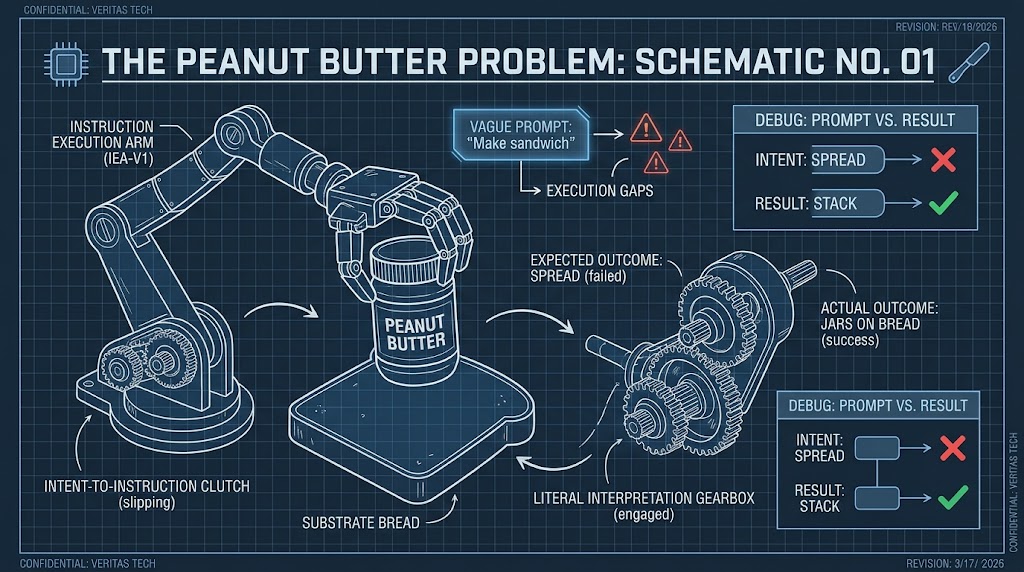
If you have ever seen the exercise where kids are asked to write instructions for making a peanut butter and jelly sandwich, you know how quickly things can fall apart. Vague commands like "Put peanut butter on the bread" result in unopened jars sitting on top of a single slice. It’s a classic lesson in the difference between intent and execution.

Why Most People Fail at AI
If you’ve ever seen the exercise where kids are asked to write instructions for making a peanut butter and jelly sandwich, you know how quickly things fall apart.
The instructions usually look something like this:
Step 1: Get the bread. Step 2: Put peanut butter and jelly on it.
Seems reasonable… until someone actually follows the instructions exactly.
So what happens?
You end up with a slice of bread sitting on a plate… with an unopened jar of peanut butter and an unopened jar of jelly placed directly on top of it.
No lid removed. No spreading. No second slice of bread. Just… compliance.
Because that’s what the instructions said to do.
It’s funny when kids do it.
It’s not so funny when professionals do it with AI.
The AI Version of the Same Mistake
Watch how most people interact with AI and you’ll see the exact same pattern:
- “Write me a business plan.”
- “Help me build an app.”
- “Create a training program.”
And then they’re surprised when the output is generic, surface-level, or just slightly off.
But the AI didn’t fail.
It followed the instructions.
The problem is the instructions were the equivalent of:
“Put peanut butter and jelly on the bread.”
No context. No sequence. No constraints. No definition of what “done” actually looks like.
So the system fills in the gaps the only way it can—statistically.
And that’s why the result feels close… but wrong.
I Learned This the Hard Way
Early on, I ran into this constantly.
I would start building something, get halfway through, and realize the outputs weren’t lining up with what I actually needed. So I’d try to “fix” it with another prompt. And another. And another.
And it wouldn’t work.
Not because the AI couldn’t do it—but because I hadn’t been clear from the start.
At a certain point, it became faster to scrap what I had and start over than to keep trying to patch vague instructions.
That was the moment it clicked:
If the foundation is unclear, everything built on top of it will be unstable.
The Real Problem Isn’t AI
Most people think they’re struggling with AI because it’s new, complex, or unpredictable.
That’s not it.
They’re struggling because they’ve never had to think in precise, executable steps.
For most of our careers, we’ve been able to rely on shared context:
- Other humans “just get it”
- Teams fill in gaps automatically
- Experience smooths over vague instructions
AI doesn’t do that.
It doesn’t share your context. It doesn’t know what you “meant.” It doesn’t correct your thinking.
It just executes.
Exactly. Literally. Consistently.
Which means it exposes every assumption you didn’t realize you were making.
The Assumption Gap
This is where most people break down.
They assume:
- The context is obvious
- The AI knows what they mean
- The system will “figure it out.”
But AI has none of that.
No lived experience. No shared mental model. No implicit understanding.
So when your instructions have gaps, it fills them in the only way it can.
Not intelligently. Not intentionally.
Predictively.
And prediction is not the same thing as understanding.
The Shift: From Asking to Instructing
If you want better results from AI, you have to change how you think about the interaction.
You’re not asking for help.
You’re designing instructions for execution.
That’s a completely different mindset.
Clear inputs create clear outputs. Every time.
So instead of saying:
“Create a training program.”
You start thinking in terms of:
- Who is this for?
- What problem are we solving?
- What constraints exist?
- What does success look like?
- What format do I need the output in?
Now you’re not hoping for a good answer.
You’re engineering one.
This Is Bigger Than AI
This is where it shifts from a tool problem to a leadership problem.
The people who will get the most out of AI aren’t the most technical.
They’re the ones who can think clearly, communicate precisely, and take ownership of outcomes.
AI doesn’t remove responsibility.
It amplifies it.
If your thinking is vague, your results will be vague. If your instructions are shallow, your outputs will be shallow.
And if AI consistently gives you poor results…
it’s not a prompt problem. It’s a thinking problem.
The Sandwich Test
Here’s the test:
If someone followed your prompt exactly—literally, step by step—would they get the outcome you actually want?
Or would they end up putting a jar of peanut butter on top of a slice of bread?
Because AI will do exactly what you tell it to do.
No interpretation. No correction. No intent.
Just execution.
And in a world where execution is increasingly automated,
clarity is no longer a soft skill.
It’s the skill.
So the next time AI gives you something that feels “off,” don’t immediately assume the tool is the problem.
Look at the instructions.
Because more often than not, you didn’t give it a recipe. You gave it a suggestion.
Written by Kyle P. Atkins, Ed.S., PMP, CVAHP, NRP, eFACHDM
Founder & Chief Architect of Veritas Technology Solutions , and author of The Healthcare Leader’s Guide to AI and SAFEHARBOR: A BLACKBOX Story .
More in Clinical AI & Governance
Leadership Dispatch
Occasional essays on healthcare AI governance, clinical education, and executive leadership. Sent directly when a new article or resource is published—no weekly filler.