The Productive Struggle: Reframing failure in the age of Artificial Intellegence
If failure is unacceptable, learning becomes impossible. In an era obsessed with perfection, we’ve lost sight of the role productive struggle plays in building resilient systems, strong leaders, and meaningful innovation.

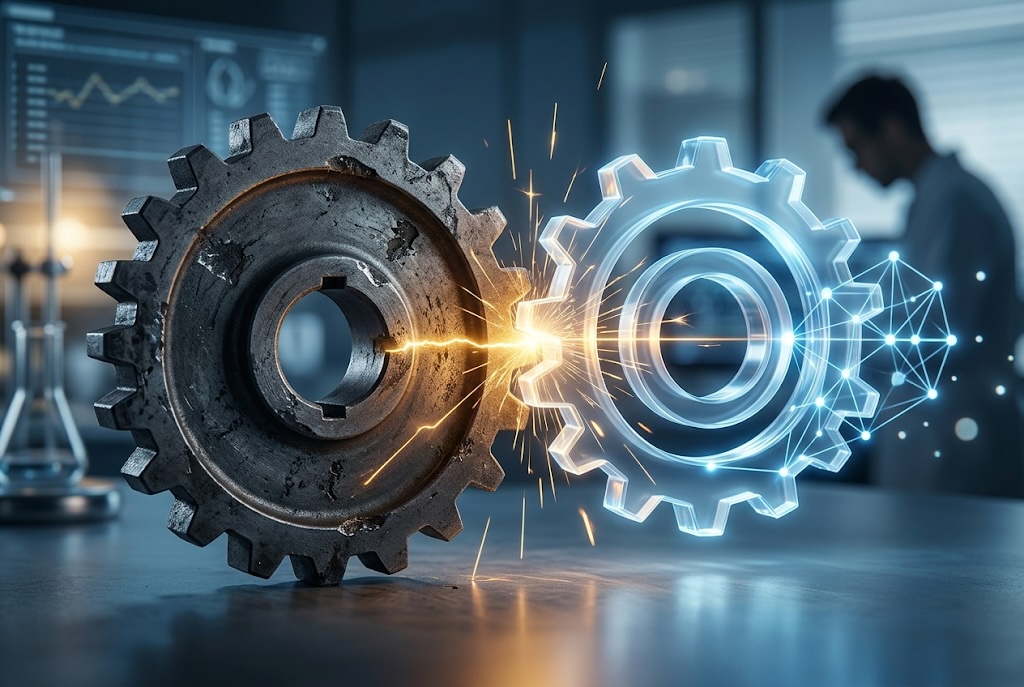
The Productive Struggle
We live in a moment that has become strangely intolerant of failure.
An app goes down for a little while and people act like the company is incompetent. An AI tool gives an imperfect answer and suddenly the whole thing is written off as useless. A new system has friction, confusion, or a rough edge, and we treat that as proof that it never should have existed in the first place.
That mindset sounds disciplined on the surface, but it is actually one of the fastest ways to kill innovation.
Somewhere along the way, we started expecting production-level perfection during the experimentation phase. We want flawless outputs from tools that are still being learned, refined, and integrated. We want reliability without iteration. We want breakthroughs without struggle. We want success without the part that usually creates it.
That is not how progress works.
We Are Judging the Wrong Things
One of the clearest examples of this shows up in how people talk about AI.
Someone asks it to count the number of “r’s” in strawberry. Someone else asks whether they should walk or drive to the car wash to wash their car. Then, when the response is awkward, incomplete, or strange, they declare that AI is broken.
That is not serious evaluation. It is a parlor trick.
Those examples do not prove that AI has no value. They prove that people are often more interested in catching a system looking foolish than understanding what it is actually for. It is like mocking a power drill because it cannot paint a wall. The failure is not always in the tool. Sometimes it is in the test.
AI should absolutely be challenged. It should be examined carefully. It should not be trusted blindly. But there is a difference between honest scrutiny and bad-faith gotchas.
If a tool fails at a meaningful task in a meaningful context, that matters. If a tool struggles with an oddly framed, low-value trick question, that tells us far less than people want to admit.
We have started confusing “this tool did not handle my nonsense perfectly” with “this tool has no legitimate use.” Those are not the same thing.
Failure Is Not the Enemy
The bigger issue is that many people no longer seem to have a category for productive failure.
Failure is not automatically good. Sloppiness is not noble. Carelessness is not innovation. Repeating the same mistake over and over without learning anything is not resilience. But failure, in the right context, is one of the most useful teachers we have.
Failure shows us where assumptions break down. It exposes weak architecture. It reveals blind spots in planning. It forces us to stop pretending and start learning.
That is true in software. It is true in leadership. It is true in business. It is true in education. It is true in AI.
The goal is not to fail recklessly. The goal is to fail in ways that produce insight.
That is a very different thing.
The People We Admire Usually Failed a Lot
We love to celebrate inventors, builders, and visionaries after the fact. We talk about Edison, Ford, and others as if they simply saw the future more clearly than everyone else and moved toward it with confidence.
That is a polished version of history.
The real story is much messier.
Thomas Edison did not arrive at success by avoiding failure. He got there through repeated attempts, wrong turns, dead ends, and constant experimentation. Whether every quote attributed to him is exact or not, the principle still holds: he treated failure like information. Each failed attempt narrowed the field. Each disappointment clarified the path.
Henry Ford did not reshape manufacturing because everything worked on the first try. He and others transformed industry by confronting inefficiency, waste, inconsistency, and limitation. The systems that changed the world were not born fully formed. They were refined through friction.
That is the part people like to skip.
We celebrate the polished outcome while quietly ignoring the productive struggle that made it possible.
Resilience Is Built, Not Claimed
There is another reason failure matters. It builds resilience.
Not the kind of resilience people post about. Real resilience.
The kind that comes from having something not work, adjusting, and moving again. The kind that comes from seeing a plan fall apart and learning how to think instead of panic. The kind that reminds you that your first approach is not your only approach.
When people or organizations become allergic to failure, they usually become fragile. They stop experimenting. They stop taking smart risks. They hide problems instead of surfacing them. They optimize for appearance over substance.
That works for a little while. Then reality shows up.
A team that cannot tolerate small failures will eventually be overwhelmed by larger ones. A leader who cannot admit a flawed decision will keep compounding it. An organization that demands perfection too early often delays growth so long that it mistakes stagnation for stability.
AI Does Not Remove Struggle
This is especially important right now because many people still seem to think AI should remove struggle entirely.
It will not.
AI can accelerate work. It can reduce friction. It can help people think faster, draft faster, analyze faster, and test ideas faster. But it does not eliminate the need for judgment. It does not remove ambiguity. It does not erase the responsibility of leadership.
If anything, AI changes where the struggle happens.
The struggle is no longer just in producing the output. It is in defining the problem well. It is in asking better questions. It is in reviewing answers critically. It is in knowing what matters, what does not, and when a response is good enough for the task at hand.
That is why organizations waiting for AI to become flawless before they engage with it are already behind. They are asking a developing capability to meet a standard that no major system in history has ever met at the beginning.
What matters is not whether failure appears. It is whether failure produces learning, stronger design, and wiser use.
The Real Question
The real question is not whether failure will happen.
It will.
The real question is whether we know how to use it.
Do we treat every misstep like proof that progress was a mistake? Or do we learn how to distinguish between pointless failure and productive struggle?
Because that distinction matters.
Pointless failure is careless, repetitive, and empty. Productive struggle is disciplined, revealing, and forward-moving. One wastes time. The other creates strength.
We do not need a culture that celebrates failure for its own sake. We need one that understands what failure is for.
If we expect perfection too early, we will build very little. If we treat every rough edge like a reason to stop, we will become experts at criticism and amateurs at progress.
Failure is not inherently bad. In the right hands, it becomes instruction. It becomes pressure that strengthens thinking. It becomes the friction that produces clarity.
And more often than not, it becomes the thing that makes success durable when it finally arrives.
Written by Kyle P. Atkins, Ed.S., PMP, CVAHP, NRP, eFACHDM
Founder & Chief Architect of Veritas Technology Solutions , and author of The Healthcare Leader’s Guide to AI and SAFEHARBOR: A BLACKBOX Story .
More in Clinical AI & Governance
Leadership Dispatch
Occasional essays on healthcare AI governance, clinical education, and executive leadership. Sent directly when a new article or resource is published—no weekly filler.