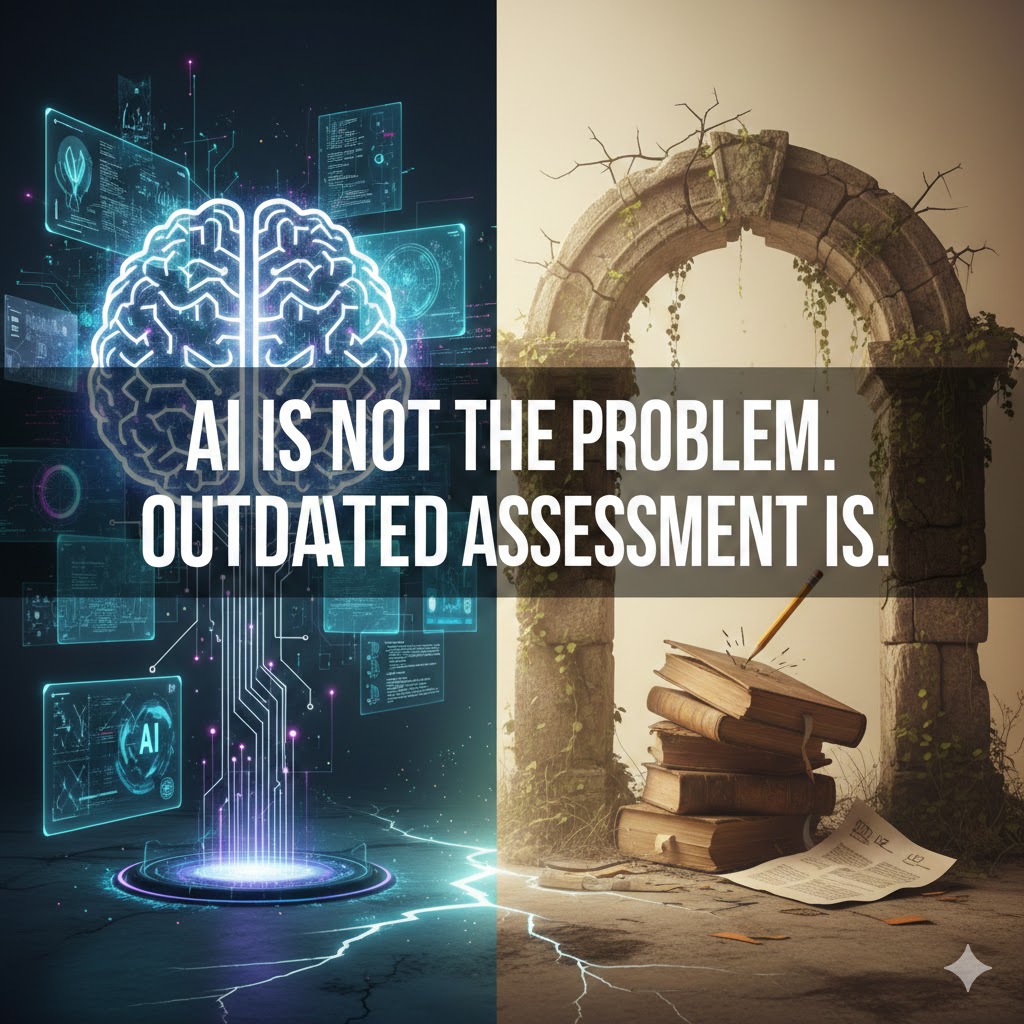
AI Is Not the Problem. Outdated Assessment Is.
AI has forced higher education to confront an uncomfortable truth: many of our assessments were built for efficiency, not authenticity. When students can generate polished text instantly, we must ask whether we were measuring learning — or simply measuring production. The solution isn’t prohibition. It’s redesign. By shifting toward process-based evaluation, scenario-based learning, oral defense, and AI transparency, institutions can transform this moment from crisis into catalyst. AI isn’t the threat. Stagnation is.

Last week I had the opportunity to join the Smarter Campus podcast to talk about AI as a thought partner in higher education — what it means for ethics, integrity, and the future of learning.
But the more I’ve reflected on that conversation, the more convinced I am of something that needs to be said clearly:
AI is not the problem.
Outdated assessment is.
If a student can paste your entire assignment into a model and receive a polished submission in 30 seconds, the issue isn’t the model.
The issue is that the assignment was never designed for an AI-enabled world.
Higher education assessment models were built for a world where producing text required effort. That world no longer exists.
The question now isn’t whether students will use AI.
They will.
The question is whether we are going to redesign assessment intentionally — or react defensively.
We Confused Output With Learning
For decades, we have equated visible output with internal learning.
If a student can produce 1,500 words on a topic, we assume they’ve wrestled with the material.
But AI has exposed the weakness in that assumption.
Learning is not the same thing as generating text.
Learning is:
- Making decisions under ambiguity
- Defending reasoning
- Integrating feedback
- Demonstrating transfer
- Applying knowledge in context
AI can generate a competent paper.
It cannot convincingly defend reasoning in real time. It cannot demonstrate ownership of intellectual development. It cannot reflect on growth in a personally authentic way.
If we design assessment around ownership and application instead of static output, the integrity panic loses its fuel.
The Cheating Narrative Is Too Small
We are currently treating AI like a sophisticated cheating device.
That framing is reductive.
AI is becoming cognitive infrastructure. It will be embedded in the workforce our students are entering. Pretending otherwise isolates academia from reality.
The real question is not:
“How do we stop students from using AI?”
It is:
“What does responsible, transparent, skill-building AI use look like inside a learning environment?”
That is a leadership question. And it requires structural change.
Practical Shifts Institutions Can Make Now
1. Grade the Process, Not Just the Product
- Require draft checkpoints.
- Include revision logs.
- Ask for reflective memos explaining decision-making.
- Review version history when available.
When thinking becomes visible, integrity improves.
2. Require AI Transparency Statements
Add a required section to assignments:
- Did you use AI?
- How did you use it?
- How did you verify accuracy?
- What did you reject and why?
This reframes AI from shortcut to tool requiring judgment.
3. Add Oral or Live Defense Components
For major assessments, include:
- Short oral defenses
- Live Q&A discussions
- Recorded explanation of reasoning
AI can draft arguments. It cannot defend understanding under scrutiny.
4. Use Scenario-Based Learning
Instead of generic essays, incorporate applied prompts:
“Here is an institutional AI adoption proposal. Identify governance risks and defend mitigation strategies.”
Now the student must analyze, prioritize, and justify.
5. Redesign Rubrics Around Judgment
De-emphasize:
- Word count
- Citation volume
- Formatting precision
Emphasize:
- Depth of reasoning
- Integration of counterarguments
- Contextual awareness
- Ethical consideration
- Original synthesis
6. Build AI Literacy Into Curriculum
Teach students:
- How AI works
- Its limitations
- Bias and hallucination risks
- How to fact-check outputs
- How to disclose responsible use
Prohibition breeds secrecy. Literacy builds discernment.
Assessment Redesign Checklist
If you are a faculty member or administrator looking to act immediately, use this checklist as a starting point:
Assessment Audit
- ☐ Can this assignment be fully completed by AI without meaningful human reasoning?
- ☐ Are we grading final output more heavily than intellectual process?
- ☐ Does the rubric measure formatting more than judgment?
- ☐ Would this assessment look different if AI did not exist?
Redesign Actions
- ☐ Add at least one process checkpoint.
- ☐ Incorporate a reflection or defense component.
- ☐ Require AI transparency statements.
- ☐ Shift at least 30% of grading weight toward reasoning and application.
- ☐ Introduce one applied or scenario-based assessment this term.
Leadership-Level Questions
- ☐ Are faculty receiving structured support for redesign?
- ☐ Do we have a clear AI governance framework?
- ☐ Are we reacting to AI — or strategically integrating it?
The Opportunity in Front of Us
Some of our traditional assessment models were never strong measures of learning.
They were scalable. They were standardized. They were administratively efficient.
AI did not destroy strong pedagogy.
It exposed weak pedagogy.
And that exposure is uncomfortable.
But it is also an opportunity.
The institutions that thrive will not be the ones with the strictest bans.
They will be the ones who redesign the earliest.
AI is not the problem.
Outdated assessment is.
And if we are willing to rethink how we measure learning, this moment could strengthen higher education rather than destabilize it.
Written by Kyle P. Atkins, Ed.S., PMP, CVAHP, NRP, eFACHDM
Founder & Chief Architect of Veritas Technology Solutions , and author of The Healthcare Leader’s Guide to AI and SAFEHARBOR: A BLACKBOX Story .
More in Clinical AI & Governance
Leadership Dispatch
Occasional essays on healthcare AI governance, clinical education, and executive leadership. Sent directly when a new article or resource is published—no weekly filler.