Competence over Compliance: Reimagining Assessment in Public Safety
Why are we still using multiple-choice tests to certify the people we trust with our lives? It's time to shift to AI-driven, high-fidelity competence assessment.

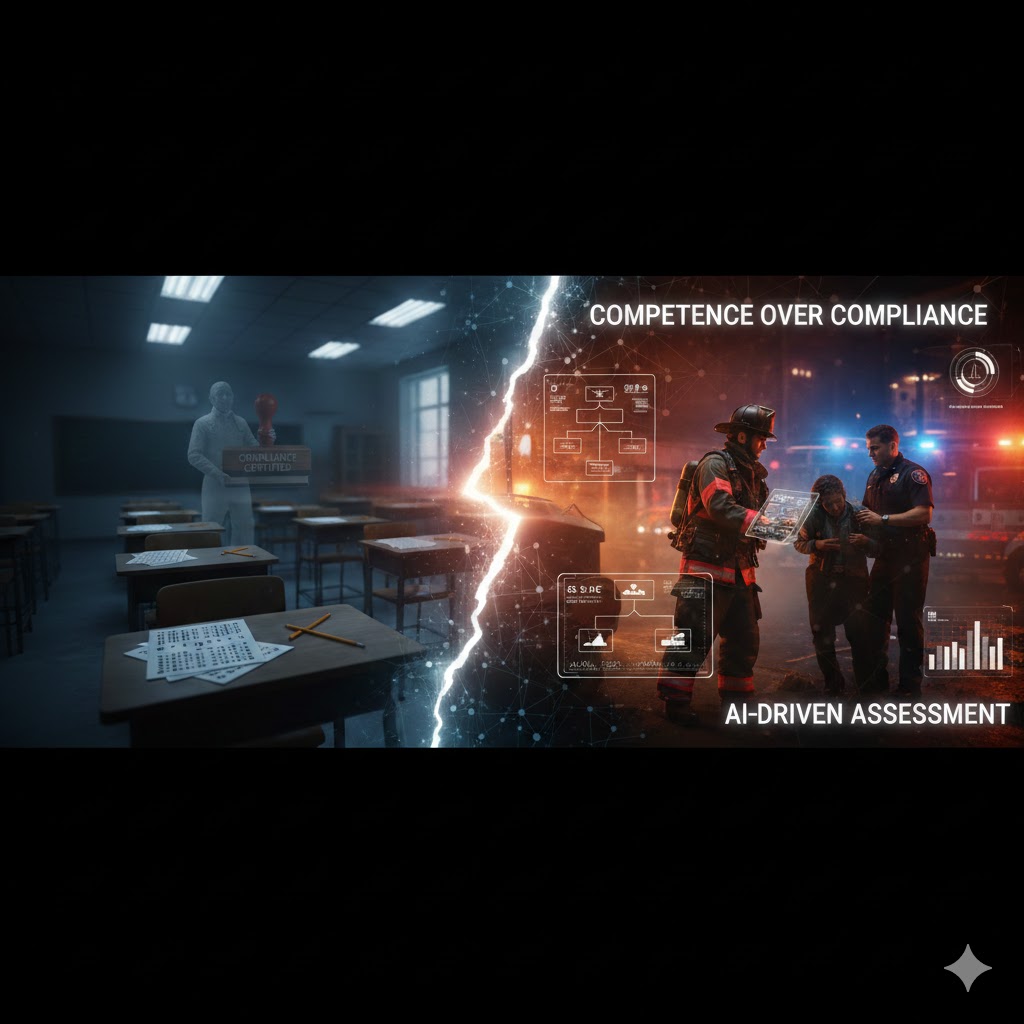
The Compliance Trap
In the public safety sector—EMS, Fire, Law Enforcement—we have a dangerous obsession with compliance. We check boxes. We log hours. We sit through mandated training that everyone quietly refers to as “death by PowerPoint.” We take exams that reward memorization over judgment and recall over readiness. Once the paperwork is complete, we tell ourselves that education has occurred.
But that belief is increasingly detached from reality. Much of our current training infrastructure exists less to create competent professionals and more to create legal insulation. It is designed to answer one narrow question: “Can we prove they were trained?” It rarely asks the harder, more important one: “Can they actually perform when it matters?” Education in this space is broken not because instructors don’t care or learners aren’t motivated, but because the system itself optimizes for legal defense rather than operational competence.
That distinction matters more than we like to admit. When a system prioritizes compliance over competence, it doesn’t just waste time—it creates risk. It produces providers who are technically qualified on paper but underprepared in practice. And in public safety, that gap doesn’t show up on an audit report. It shows up on a sidewalk, in a living room, or on the side of a highway, when someone’s life depends on the decisions made in the next thirty seconds.
Compliance has become the proxy for quality because it is easy to measure. Hours are countable. Certificates are printable. Exams can be graded automatically. True competence, by contrast, is messy. It lives in gray areas. It involves judgment calls, ethical tensions, emotional regulation, and the ability to adapt when the situation does not follow the script. Those are precisely the skills our current systems are least equipped to assess.
This is where artificial intelligence fundamentally changes what is possible. Not by replacing educators or automating learning for its own sake, but by giving us tools that finally allow assessment to match the reality of the work. AI gives us a new way to measure competence—one that goes beyond static questions and binary answers. We can now create high-fidelity simulations that adapt to the learner’s performance in real time, introducing stress, ambiguity, and consequence in a controlled environment. We can observe how decisions are made, not just whether the final answer matches a key. We can assess judgment, empathy, communication, and technical skill in ways a Scantron never could.
High-Fidelity Learning
The goal of education in public safety should never be the certificate. The certificate is a side effect, not the outcome. The real goal is much simpler—and much heavier: when the 911 call comes, the person responding must be capable. That means being capable of thinking clearly under pressure, adapting to imperfect information, communicating with frightened people, and executing technical skills while everything around them is moving.
Achieving that goal requires an inward shift in how we design curriculum. Instead of starting with regulatory requirements and working outward, we must start with the terminal objective—the saved life—and work backward to the training. We have to ask uncomfortable but necessary questions. What decisions must be made correctly for this patient to survive? Where do providers most often hesitate, freeze, or make errors? Which mistakes are recoverable, and which ones are catastrophic? What does competent performance actually look like in the real world, not in a classroom?
Once you start from that perspective, the limitations of traditional education become obvious. Multiple-choice exams are efficient, but they assess recognition rather than reasoning. Lectures can convey information, but they cannot replicate the cognitive load of a real scene. Skills check-offs demonstrate isolated tasks, but they rarely capture how those tasks interact under stress. We end up training components instead of performance.
Imagine a training system that doesn’t just ask, “What is the dose of epinephrine?” but instead places the learner inside a chaotic pediatric anaphylaxis scenario.
There is a panicked parent demanding answers. The patient’s condition is deteriorating. The environment is loud and distracting. Time pressure is mounting. A partner misses a critical cue. The learner must assess, decide, communicate, and act—all at once.
The evaluation isn’t whether the learner remembers a number; it’s whether they can synthesize information, manage the scene, administer the medication correctly, and maintain situational awareness at the same time.
That is a competence assessment. Everything else is documentation.
High-fidelity learning doesn’t eliminate the need for foundational knowledge. It contextualizes it. Facts matter, but facts are only useful when they can be applied correctly under pressure. By embedding knowledge in realistic scenarios, we train providers to retrieve and use information as they will need it—in incomplete, time-constrained, and emotionally charged contexts.
The Future of Professional Mastery
One of the most persistent challenges in public safety education has been the lack of experience. True competence is built through exposure—seeing patterns across cases, making mistakes, reflecting on outcomes, and learning from mentors. But experience is unevenly distributed. Some providers encounter complex, high-acuity situations early and often. Others may go years without seeing certain critical scenarios. Mentorship, while invaluable, is resource-intensive and difficult to scale.
AI changes that equation in a meaningful way. We can now simulate experience. Not perfectly, and not as a replacement for real-world practice, but in a way that is repeatable, measurable, and accessible. Learners can be repeatedly exposed to rare but high-risk scenarios. Their decisions can be reviewed, replayed, and debriefed. Patterns in performance can be identified early, enabling targeted remediation rather than generic retraining.
When designed well, this doesn’t lower standards—it raises them. Competence is no longer assumed after a single exam or annual refresher. It is repeatedly demonstrated across varied contexts, with increasing complexity. Weaknesses are surfaced rather than hidden behind passing scores. Growth becomes visible.
This is ultimately an ethical issue. We owe it to the public to ensure that those responding in their worst moments are genuinely prepared, not merely compliant. We owe it to providers to provide education that respects the complexity of their work rather than reducing it to a checkbox exercise. Compliance will always exist. It has to. Regulations, accreditation, and accountability are necessary. But compliance should be the floor, not the ceiling.
AI gives us the opportunity—perhaps the responsibility—to build systems that prioritize judgment over memorization, performance over paperwork, and outcomes over optics. We can stop designing education primarily to defend ourselves after something goes wrong and start designing it to prevent failure in the first place.
Let’s move beyond the illusion that hours equal competence. Let us build training systems that reflect the realities of the work. And let’s start building, intentionally and unapologetically, for the saved life.
Written by Kyle P. Atkins, Ed.S., PMP, CVAHP, NRP, eFACHDM
Founder & Chief Architect of Veritas Technology Solutions , and author of The Healthcare Leader’s Guide to AI and SAFEHARBOR: A BLACKBOX Story .
More in Clinical AI & Governance
Leadership Dispatch
Occasional essays on healthcare AI governance, clinical education, and executive leadership. Sent directly when a new article or resource is published—no weekly filler.