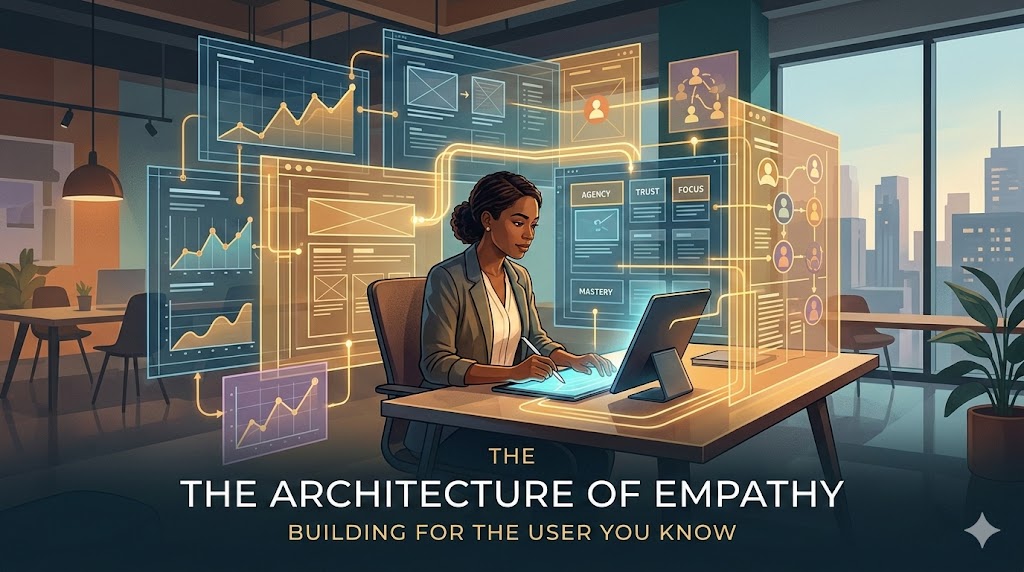
The Architecture of Empathy: Building for the User You Know
Strategy isn't about market segments; it's about the deep, empathetic understanding of the individual user's pain.

Beyond the Persona
In the SaaS world, we talk a lot about “user personas.” We create these cardboard cutouts of people and give them names like “Marketing Mary” or “Developer Dan.” We assign them pain points, preferred tools, and budget ranges. We print them on slides and build strategy decks around them.
But strategy built on cardboard is doomed to fail.
A persona is a starting point. It is not a substitute for understanding. If we stop at the persona level, we end up designing for stereotypes instead of people. We optimize for assumed behavior instead of lived reality. And eventually, the gap between what we built and what users actually need becomes painfully obvious.
To build something that truly moves the needle, you need an Architecture of Empathy.
Empathy isn’t just a soft skill reserved for HR or customer success. It’s a strategic asset. It’s a design constraint. It’s a product requirement. Empathy requires looking beyond what the user says they want and understanding what they actually need. It means asking harder questions:
- What pressure are they under when they open this app?
- What risk do they carry if they get this decision wrong?
- What cognitive load are we adding to their already full day?
When I look at the systems we build, I don’t just ask, “Does this function?” I ask, “Does this respect the user’s intelligence?” An empathetic architecture is one that doesn’t hide complexity behind vague “magic,” but instead empowers the user to understand and master that complexity.
There’s a difference between simplification and infantilization. The former removes friction. The latter removes agency. And users can feel the difference.
Designing for Agency
Too often, we design as if users are bugs in the system—unpredictable variables that need to be controlled, nudged, or cornered into the “correct” behavior. We implement dark patterns to drive clicks. We bury meaningful options behind upsells. We optimize funnels while eroding trust.
That isn’t strategy. That’s short-term extraction.
An empathetic strategy treats users as agents. Capable. Intelligent. Motivated. It assumes they want to do good work and make sound decisions. Our job isn’t to manipulate them into outcomes; it’s to equip them for outcomes.
We should build systems that provide agency, not just automation.
Automation has its place. It can remove repetitive tasks, surface insights faster, and scale expertise. But when automation becomes a black box that strips away visibility and control, we create dependence instead of empowerment. The system may be efficient, but the user becomes weaker inside it.
Agency means giving users the steering wheel—even if we’re providing the engine. It means:
- Showing the reasoning behind AI-generated outputs.
- Allowing users to override recommendations.
- Making assumptions visible instead of hidden.
When we design for agency, we’re not just building software. We’re building competence.
This “intent-inward” philosophy starts with a simple discipline: focus. We respect the user’s attention as a scarce resource. We don’t distract them with unnecessary notifications, gamified noise, or vanity metrics. We make the most important things the easiest things.
That is the architecture of empathy in action.
Complexity Isn’t the Enemy
There’s a dangerous myth in product design that everything must be effortless. “Make it frictionless.” “Make it invisible.” “Make it one click.”
But some domains are inherently complex. Healthcare is complex. Education is complex. Finance is complex. If we pretend those systems are simple, we don’t eliminate complexity—we just relocate it. Usually onto the user.
An empathetic architecture acknowledges reality. It says, “This is complicated. Let’s navigate it together.” Instead of masking complexity, it scaffolds it. It layers information in a way that allows growth. It assumes users can level up.
When you respect the intelligence of your users, you attract serious professionals. When you design for mastery instead of mere consumption, you create tools that become part of someone’s identity—not just their workflow.
Strategy as a Relationship
Your product strategy is the way you talk to your users. It communicates your values more loudly than your marketing copy ever will.
If your strategy is cold, hyper-efficient, and purely extractive, that’s the relationship you will cultivate. Users will treat you transactionally because you treated them transactionally. They will churn the moment a cheaper alternative appears.
If your strategy is thoughtful, empowering, and helpful—even when it costs you in the short term—you build something far more durable: trust.
Trust is earned when:
- You don’t hide pricing behind unnecessary friction.
- You don’t manipulate metrics to inflate perceived value.
- You design updates that genuinely improve the user’s work, not just your valuation.
Loyalty built on trust is something no marketing budget can buy. It is the byproduct of consistent empathy embedded into architecture.
When users feel seen—not segmented—they engage differently. They provide better feedback. They advocate organically. They forgive missteps because they believe in your intent.
Build for the Person, Not the Persona
Personas are useful tools. But they are not the end goal. The end goal is building something that recognizes the human on the other side of the screen.
An Architecture of Empathy requires discipline. It requires saying no to manipulative growth tactics. It requires designing for long-term competence instead of short-term engagement spikes. It requires asking, over and over: “If I were in their position, under their pressure, would this feel respectful?”
Empathy is not weakness. It is clarity about who the product exists for and why.
When you build for the person—not the persona—you stop optimizing for cardboard cutouts and start designing for real lives. And that is where strategy stops being theoretical and starts becoming transformational.
Written by Kyle P. Atkins, Ed.S., PMP, CVAHP, NRP, eFACHDM
Founder & Chief Architect of Veritas Technology Solutions , and author of The Healthcare Leader’s Guide to AI and SAFEHARBOR: A BLACKBOX Story .
More in Clinical AI & Governance
Leadership Dispatch
Occasional essays on healthcare AI governance, clinical education, and executive leadership. Sent directly when a new article or resource is published—no weekly filler.