Beyond the Org Chart: Building Teams in an AI-Augmented World
The traditional org chart is dead. In the AI era, teams should be organized around information flow and collaborative intelligence.

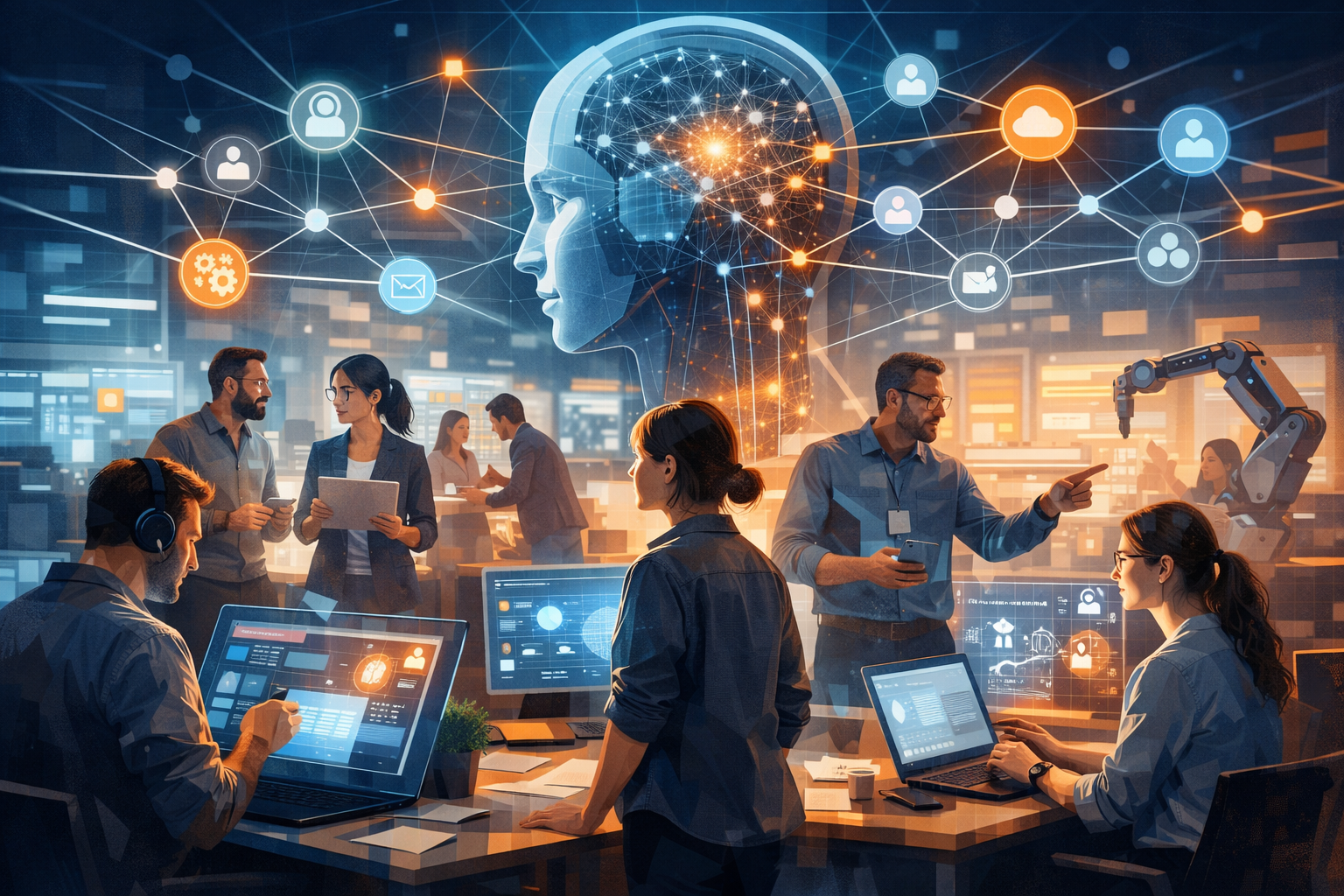
Artificial intelligence isn’t just changing how work gets done—it’s changing how teams should be built. The assumptions baked into traditional org charts are increasingly misaligned with a world where capability is fluid, knowledge is augmented, and collaboration happens faster than hierarchy can keep up.
The Death of the Silo
The way we organize humans at work is still rooted in the factory era. We build silos, hierarchies, and reporting chains that were designed for predictability, control, and repeatability. That model made sense when work was linear, and outputs were physical. It makes far less sense in a knowledge-driven, AI-augmented world.
Most org charts today still answer one primary question: “Who controls whom?” That framing is increasingly outdated. In an environment where information moves instantly, and tools can augment nearly every cognitive task, the most valuable organizational trait is no longer control. It’s flow.
When every team member effectively has a polymath in their pocket through large language models, the boundaries between roles begin to blur. Designers can write functional code. Analysts can generate compelling narratives. Engineers can draft strategy documents. The rigid separation of responsibilities that once defined departments starts to collapse under its own weight.
This doesn’t mean roles disappear. It means they soften. The leader’s job is no longer to police boundaries or protect turf. It’s to facilitate connections, remove friction, and create conditions where talent can move fluidly to wherever it creates the most value.
The organizations that cling to silos will find themselves slower, more political, and increasingly brittle. The ones that adapt will feel uncomfortable at first—but they will move, learn, and recover faster when things change.
The Neural Network Organization
Building teams in an AI-augmented world is less like assembling a machine and more like cultivating a neural network. Each node—each human—has its own strengths, context, and experience. The power of the system doesn’t come from rigid structure, but from the quality of the connections between nodes.
In a neural network organization, information is not hoarded as a source of power. It’s shared deliberately as a source of leverage. High-trust cultures become non-negotiable because, without trust, flow collapses. People stop sharing early ideas. They stop experimenting. They wait for permission rather than act.
This is where “intent-inward” leadership matters. Leaders who understand that their teams are living systems—not spreadsheets of interchangeable resources—design differently. They focus less on enforcing compliance and more on creating clarity. Clear intent allows teams to self-organize without chaos.
In this model, the manager’s role fundamentally changes. The manager becomes less of a supervisor and more of a router. Their job is to ensure the right information reaches the right people at the right time. They remove obstacles. They align priorities. They provide context rather than commands.
When this works, execution speeds up dramatically. Decisions happen closer to the work. Teams don’t wait for approval on every step because they understand the direction and the constraints. AI tools amplify this effect by lowering the cost of exploration, drafting, and iteration.
From Oversight to Enablement
One of the most common leadership failures in AI-enabled environments is mistaking visibility for value. Just because you can monitor everything doesn’t mean you should. Surveillance-oriented management kills trust and turns powerful tools into sources of anxiety.
AI should not be used to tighten the leash. It should be used to remove unnecessary weight. When leaders shift from oversight to enablement, teams respond with higher ownership and better judgment. People are far more capable of self-direction than most organizational systems allow.
This requires leaders to become comfortable with ambiguity. In a fluid system, not every action fits neatly into a job description. Contributions overlap. Credit is shared. That can feel threatening in cultures that equate authority with control.
But the alternative is worse. Over-specified roles in a fast-changing environment lead to stagnation. People wait for permission because “it’s not my job.” Innovation slows because crossing boundaries feels risky.
Stewardship of Talent
The best teams of the future will be those in which humans do the most human work: judgment, empathy, ethical reasoning, and long-range strategy. AI excels at the “work-about-work”—drafting, summarizing, searching, synthesizing, and simulating. When used well, it frees people to think instead of react.
When used poorly, it turns people into “human APIs,” reduced to validating outputs, clicking buttons, or feeding systems that were meant to help them. That’s not augmentation. That’s degradation.
Leadership in an AI-augmented world is ultimately an act of stewardship. It’s about preserving the dignity of labor while increasing capability. It’s about designing systems where people feel trusted, not monitored; supported, not replaced.
This means investing in AI literacy, not just AI tools. It means giving teams permission to experiment and fail safely. It means being explicit about what decisions belong to humans and why.
Org charts will still exist. They provide structure and accountability. But they can no longer be the primary way we understand how work gets done. The real work happens in the connections between people, ideas, and machines.
Build for flow. Build for trust. Build systems that assume competence and reward collaboration. In an AI-augmented world, the organizations that thrive won’t be the ones with the most control. They’ll be the ones with the healthiest networks—human, machine, and everything in between.
Written by Kyle P. Atkins, Ed.S., PMP, CVAHP, NRP, eFACHDM
Founder & Chief Architect of Veritas Technology Solutions , and author of The Healthcare Leader’s Guide to AI and SAFEHARBOR: A BLACKBOX Story .
More in Clinical AI & Governance
Leadership Dispatch
Occasional essays on healthcare AI governance, clinical education, and executive leadership. Sent directly when a new article or resource is published—no weekly filler.