From Framework to Function: Implementing AI-Driven Tools to Support Healthcare Value Analysis Practice
The Deeper the Domain Context, the Deeper the Utility
Kyle P. Atkins, Ed.S., NRP, PMP, CVAHP, FACHDM · Veritas Technology Solutions, LLC
Abstract
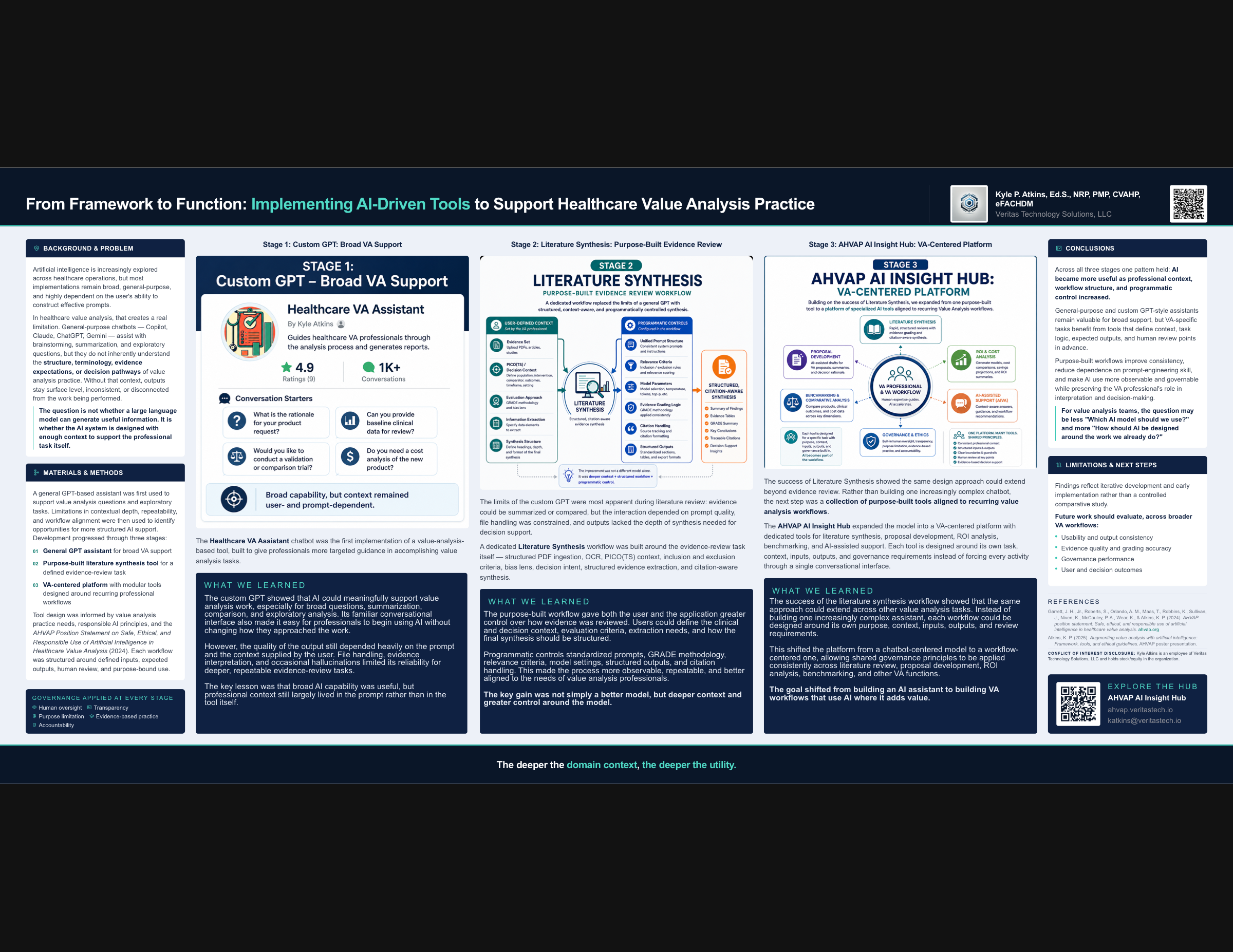
General-purpose chatbots assist with brainstorming and summarization, but they do not inherently understand the structure, terminology, evidence expectations, or decision pathways of healthcare value analysis. This poster traces the three-stage evolution from a general custom GPT assistant (1,000+ conversations) to a purpose-built PICO(TS)/GRADE Literature Synthesis engine, and finally to the national AHVAP AI Insight Hub—demonstrating that AI utility scales with domain context, workflow structure, and programmatic governance.
Poster Sections
Background & Problem
Artificial intelligence is increasingly explored across healthcare operations, but most implementations remain broad, general-purpose, and highly dependent on the user’s ability to construct effective prompts.
In healthcare value analysis, that creates a real limitation. General-purpose chatbots—Copilot, Claude, ChatGPT, Gemini—assist with brainstorming, summarization, and exploratory questions, but they do not inherently understand the structure, terminology, evidence expectations, or decision pathways of value analysis practice. Without that context, outputs stay surface-level, inconsistent, or disconnected from the work being performed.
Core Thesis: The question is not whether a large language model can generate useful information. It is whether the AI system is designed with enough context to support the professional task itself.
Materials, Methods & Governance
A general GPT-based assistant was first used to support value analysis questions and exploratory tasks. Limitations in contextual depth, repeatability, and workflow alignment were then used to identify opportunities for more structured AI support. Development progressed through three stages:
- Stage 01: General GPT assistant for broad VA support
- Stage 02: Purpose-built literature synthesis tool for a defined evidence-review task
- Stage 03: VA-centered platform with modular tools designed around recurring professional workflows
Tool design was informed by value analysis practice needs, responsible AI principles, and the AHVAP Position Statement on Safe, Ethical, and Responsible Use of Artificial Intelligence in Healthcare Value Analysis (2024). Each workflow was structured around defined inputs, expected outputs, human review, and purpose-bound use—embedding human oversight, transparency, purpose limitation, evidence-based practice, and accountability at every stage.
Stage 1 — Custom GPT: Broad VA Support
The Healthcare VA Assistant chatbot was the first implementation of a value-analysis-based tool, built to give professionals more targeted guidance in accomplishing value analysis tasks (4.9 rating across 1,000+ conversations).
What We Learned
The custom GPT showed that AI could meaningfully support value analysis work, especially for broad questions, summarization, comparison, and exploratory analysis. Its familiar conversational interface also made it easy for professionals to begin using AI without changing how they approached the work.
However, the quality of the output still depended heavily on the prompt and the context supplied by the user. File handling, evidence interpretation, and occasional hallucinations limited its reliability for deeper, repeatable evidence-review tasks.
Key Lesson: Broad AI capability was useful, but professional context still largely lived in the prompt rather than in the tool itself.
Stage 2 — Literature Synthesis: Purpose-Built Evidence Review
The limits of the custom GPT were most apparent during literature review: evidence could be summarized or compared, but the interaction depended on prompt quality, file handling was constrained, and outputs lacked the depth of synthesis needed for decision support.
A dedicated Literature Synthesis workflow was built around the evidence-review task itself—structured PDF ingestion, OCR, PICO(TS) context, inclusion and exclusion criteria, bias lens, decision intent, structured evidence extraction, and citation-aware synthesis.
What We Learned
The purpose-built workflow gave both the user and the application greater control over how evidence was reviewed. Users could define the clinical and decision context, evaluation criteria, extraction needs, and how the final synthesis should be structured. Programmatic controls standardized prompts, GRADE methodology, relevance criteria, model settings, structured outputs, and citation handling.
Key Gain: Not simply a better model, but deeper context and greater control around the model.
Stage 3 — AHVAP AI Insight Hub: VA-Centered Platform
The success of Literature Synthesis showed the same design approach could extend beyond evidence review. Rather than building one increasingly complex chatbot, the next step was a collection of purpose-built tools aligned to recurring value analysis workflows.
The AHVAP AI Insight Hub (ahvap.veritastech.io) expanded the model into a VA-centered platform with dedicated tools for literature synthesis, proposal development, ROI & cost analysis, benchmarking & comparative analysis, and governance/ethics resources. Each tool is designed around its own task, context, inputs, outputs, and governance requirements instead of forcing every activity through a single conversational interface.
What We Learned
This shifted the platform from a chatbot-centered model to a workflow-centered one, allowing shared governance principles to be applied consistently across literature review, proposal development, ROI analysis, benchmarking, and other VA functions. The goal shifted from building an AI assistant to building VA workflows that use AI where it adds value.
Conclusions, Limitations & Next Steps
Across all three stages one pattern held: AI became more useful as professional context, workflow structure, and programmatic control increased.
General-purpose and custom GPT-style assistants remain valuable for broad support, but VA-specific tasks benefit from tools that define context, task logic, expected outputs, and human review points in advance. Purpose-built workflows improve consistency, reduce dependence on prompt-engineering skill, and make AI use more observable and governable while preserving the VA professional’s role in interpretation and decision-making.
For value analysis teams, the question may be less “Which AI model should we use?” and more “How should AI be designed around the work we already do?”
Limitations & Future Evaluation
Findings reflect iterative development and early implementation rather than a controlled comparative study. Future work should evaluate usability and output consistency, evidence quality and grading accuracy, governance performance, and user/decision outcomes across broader VA workflows.
Key Findings & Takeaways
- AI becomes measurably more useful as professional domain context, workflow structure, and programmatic control increase.
- Moving from a single conversational chatbot to purpose-built workflows (PICO(TS) Literature Synthesis, ROI analysis, benchmarking) reduces reliance on prompt engineering and improves auditability.
- For value analysis teams, the core question is not which AI model to use, but how AI should be designed around the clinical and operational work already being performed.