Augmenting Value Analysis with Artificial Intelligence: Frameworks, Tools and Ethical Guardrails
Frameworks, Tools, and Ethical Guardrails for Healthcare Value Analysis
Kyle P. Atkins, Ed.S., PMP, CVAHP, NRP, FACHDM · Veritas Technology Solutions, LLC
Recorded Poster Walkthrough
Abstract
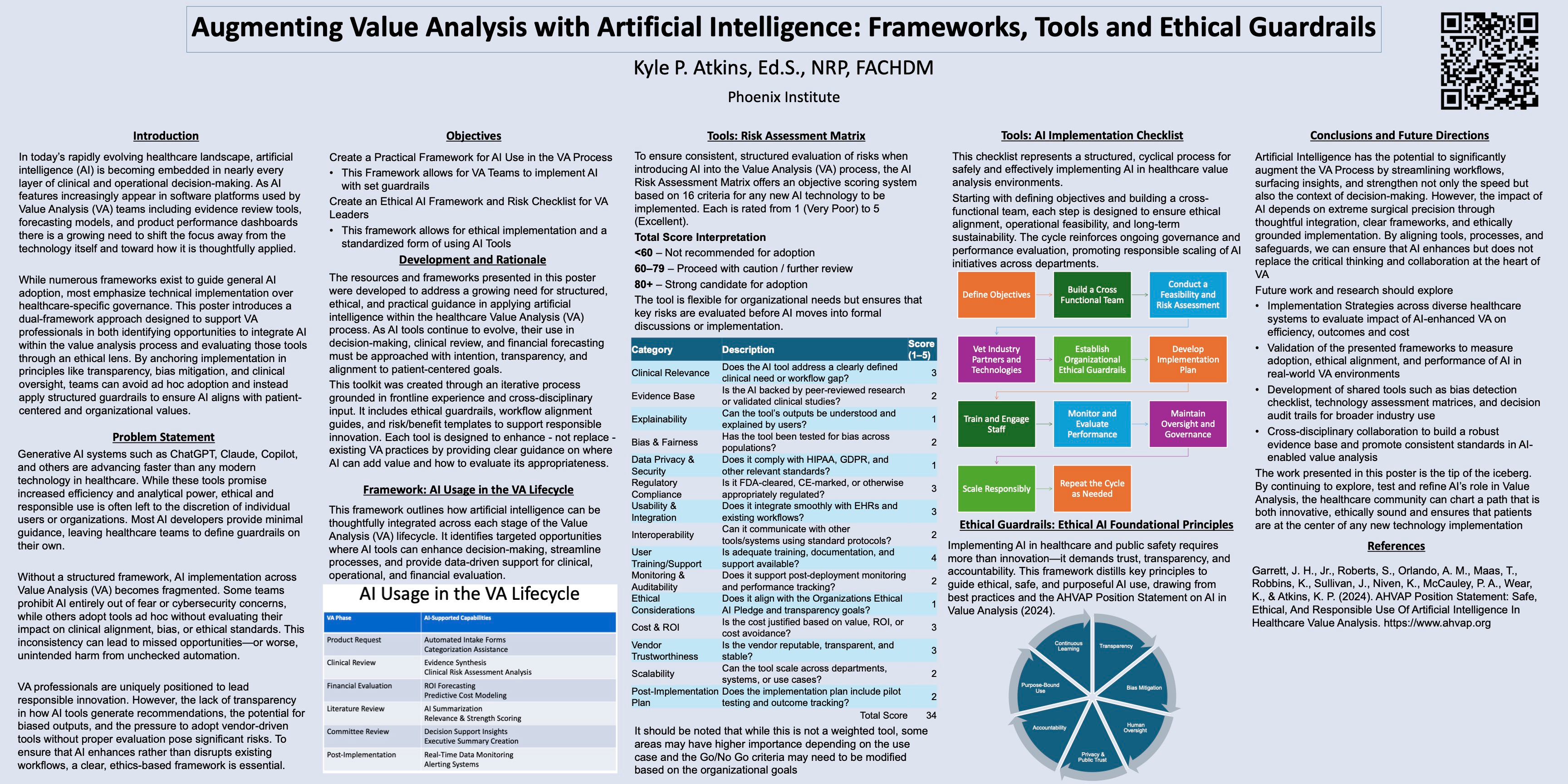
Across modern healthcare operations, artificial intelligence (AI) is becoming embedded in nearly every layer of clinical and operational decision-making. As AI features increasingly appear in software platforms used by Value Analysis (VA) teams including evidence review tools, forecasting models, and product performance dashboards there is a growing need to shift the focus away from the technology itself and toward how it is thoughtfully applied. While numerous frameworks exist to guide general AI adoption, most emphasize technical implementation over healthcare-specific governance. This poster introduces a dual-framework approach designed to support VA professionals in both identifying opportunities to integrate AI within the value analysis process and evaluating those tools through an ethical lens. By anchoring implementation in principles like transparency, bias mitigation, and clinical oversight, teams can avoid ad hoc adoption and instead apply structured guardrails to ensure AI aligns with patient-centered and organizational values.
Poster Sections
Introduction
Problem Statement
Generative AI systems such as ChatGPT, Claude, Copilot, and others are advancing faster than any modern technology in healthcare. While these tools promise increased efficiency and analytical power, ethical and responsible use is often left to the discretion of individual users or organizations. Most AI developers provide minimal guidance, leaving healthcare teams to define guardrails on their own.
Without a structured framework, AI implementation across Value Analysis (VA) becomes fragmented. Some teams prohibit AI entirely out of fear or cybersecurity concerns, while others adopt tools ad hoc without evaluating their impact on clinical alignment, bias, or ethical standards. This inconsistency can lead to missed opportunities—or worse, unintended harm from unchecked automation.
VA professionals are uniquely positioned to lead responsible innovation. However, the lack of transparency in how AI tools generate recommendations, the potential for biased outputs, and the pressure to adopt vendor-driven tools without proper evaluation pose significant risks. To ensure that AI enhances rather than disrupts existing workflows, a clear, ethics-based framework is essential.
Objectives
Create a Practical Framework for AI Use in the VA Process
Create an Ethical AI Framework and Risk Checklist for VA Leaders
Development & Rationale
The resources and frameworks presented in this poster were developed to address a growing need for structured, ethical, and practical guidance in applying artificial intelligence within the healthcare Value Analysis (VA) process. As AI tools continue to evolve, their use in decision-making, clinical review, and financial forecasting must be approached with intention, transparency, and alignment to patient-centered goals.
This toolkit was created through an iterative process grounded in frontline experience and cross-disciplinary input. It includes ethical guardrails, workflow alignment guides, and risk/benefit templates to support responsible innovation. Each tool is designed to enhance - not replace - existing VA practices by providing clear guidance on where AI can add value and how to evaluate its appropriateness.
Framework: AI Usage in the VA Lifecycle
This framework outlines how artificial intelligence can be thoughtfully integrated across each stage of the Value Analysis (VA) lifecycle. It identifies targeted opportunities where AI tools can enhance decision-making, streamline processes, and provide data-driven support for clinical, operational, and financial evaluation.
Tools: Risk Assessment Matrix
To ensure consistent, structured evaluation of risks when introducing AI into the Value Analysis (VA) process, the AI Risk Assessment Matrix offers an objective scoring system based on 16 criteria for any new AI technology to be implemented. Each is rated from 1 (Very Poor) to 5 (Excellent).
Total Score Interpretation
<60 – Not recommended for adoption
60–79 – Proceed with caution / further review
80+ – Strong candidate for adoption
The tool is flexible for organizational needs but ensures that key risks are evaluated before AI moves into formal discussions or implementation.
It should be noted that while this is not a weighted tool, some areas may have higher importance depending on the use case and the Go/No Go criteria may need to be modified based on the organizational goals
Tools: AI Implementation Checklist
This checklist represents a structured, cyclical process for safely and effectively implementing AI in healthcare value analysis environments.
Starting with defining objectives and building a cross-functional team, each step is designed to ensure ethical alignment, operational feasibility, and long-term sustainability. The cycle reinforces ongoing governance and performance evaluation, promoting responsible scaling of AI initiatives across departments.
Ethical Guardrails: Ethical AI Foundational Principles
Implementing AI in healthcare and public safety requires more than innovation—it demands trust, transparency, and accountability. This framework distills key principles to guide ethical, safe, and purposeful AI use, drawing from best practices and the AHVAP Position Statement on AI in Value Analysis (2024).
Conclusions and Future Directions
Artificial Intelligence has the potential to significantly augment the VA Process by streamlining workflows, surfacing insights, and strengthen not only the speed but also the context of decision-making. However, the impact of AI depends on extreme surgical precision through thoughtful integration, clear frameworks, and ethically grounded implementation. By aligning tools, processes, and safeguards, we can ensure that AI enhances but does not replace the critical thinking and collaboration at the heart of VA
Future work and research should explore
The work presented in this poster is the tip of the iceberg. By continuing to explore, test and refine AI’s role in Value Analysis, the healthcare community can chart a path that is both innovative, ethically sound and ensures that patients are at the center of any new technology implementation
References
Garrett, J. H., Jr., Roberts, S., Orlando, A. M., Maas, T., Robbins, K., Sullivan, J., Niven, K., McCauley, P. A., Wear, K., & Atkins, K. P. (2024). AHVAP Position Statement: Safe, Ethical, And Responsible Use Of Artificial Intelligence In Healthcare Value Analysis. https://www.ahvap.org
Key Findings & Takeaways
- Introduces a dual-framework methodology pairing operational AI utility with explicit clinical and ethical guardrails across all 5 steps of Healthcare Value Analysis.
- Includes downloadable Excel workbooks for AI Risk Assessment and AI Implementation Planning.
- Demonstrates how structured institutional context prevents generic automation errors while reducing administrative dossier preparation time.